

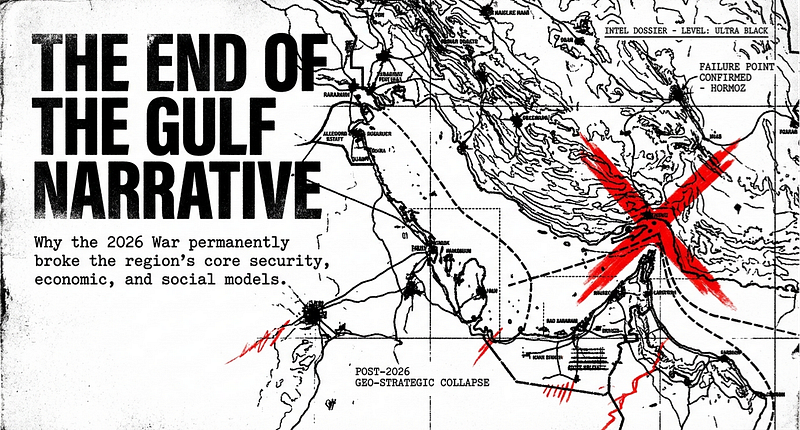
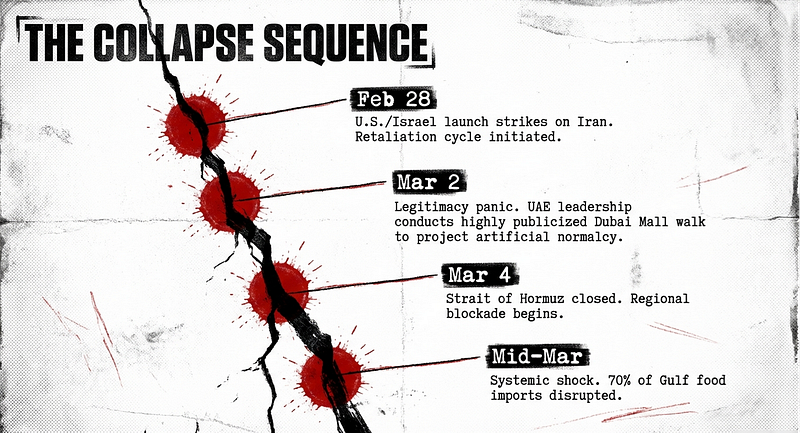
The United States and Israel launched strikes on Iran on 28 February 2026. The stated rationale was Iran’s nuclear program and its continued defiance of Western-imposed limits on its military capacity.
The International Atomic Energy Agency reported that Iran had stored highly enriched uranium in an underground facility, but said it had no evidence of an organized nuclear weapons program or that Iran was building an atomic bomb. The war began regardless.
What followed is now the defining crisis of the Gulf’s modern political order — not because of what Iran is doing to its enemies, but because of what the war is revealing about the states that aligned themselves with the attacking powers.
The Security Model That Did Not Hold
Gulf monarchies have justified their political arrangements — authoritarian rule, suppressed dissent, hereditary power — partly through the claim that they provide stability and security. That claim depended on the United States.
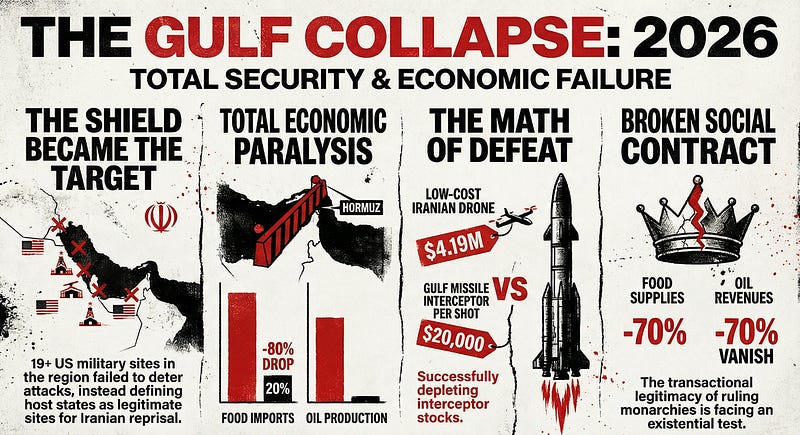
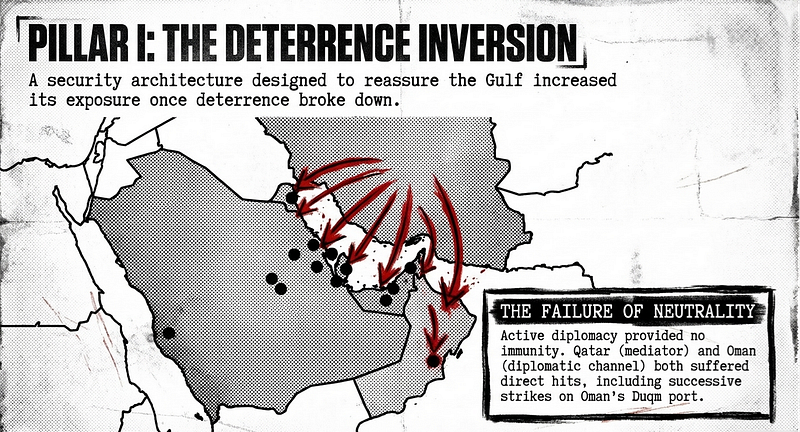
The U.S. maintains a network of bases, naval facilities, and forward operating sites across at least 19 locations in the Middle East, with eight permanent bases in the region, including in Bahrain, Kuwait, Qatar, Saudi Arabia, and the United Arab Emirates. For decades, this infrastructure was presented as a deterrent. Gulf states accepted the risks of hosting on the assumption that deterrence would hold under extreme pressure. In this war, it did not.
Not only did the bases fail to prevent Iranian retaliation against the host states, but in Tehran’s targeting logic, they helped define those states as legitimate sites of reprisal. A security architecture designed to reassure the Gulf also increased its exposure once deterrence broke down.
Political neutrality inevitably clashed on the ground with the reality of logistical and technical involvement.
From the Iranian strategic perspective, widening the range of targets was viewed as both a tactical and political necessity.
Qatar, which had helped mediate earlier ceasefires and tried to keep lines open to Tehran, was hit regardless. Oman, whose diplomats were mediating U.S.-Iran nuclear talks and whose foreign minister made a last-minute appeal for diplomacy on U.S. television, suffered successive Iranian drone attacks targeting its Duqm port complex. Neither hosting U.S. forces, nor neutrality, nor active diplomacy guaranteed protection.
The Gulf states, for the most part, preferred to avoid war, but they recognized that it was inevitable as the U.S. armada assembled and Omani mediators saw the Trump administration was barely bothering to pretend to negotiate in good faith.
They hoped for a short war that would replace top Iranian leaders with more pragmatic autocrats, presumably from the military, without shattering the state in ways that would spread instability, refugees, and uncertainty. What they got was a war of attrition with no clear end and their own territory as a theater.
HR STUDIOS is Creating Award Winning Journalism
Support our workbuymeacoffee.com
Although Trump is clearly willing to sell whatever Gulf states want to buy, that has not translated into any leader’s ability to reshape the president’s increasingly war-forward outlook — especially when that outlook aligns with Israeli priorities.
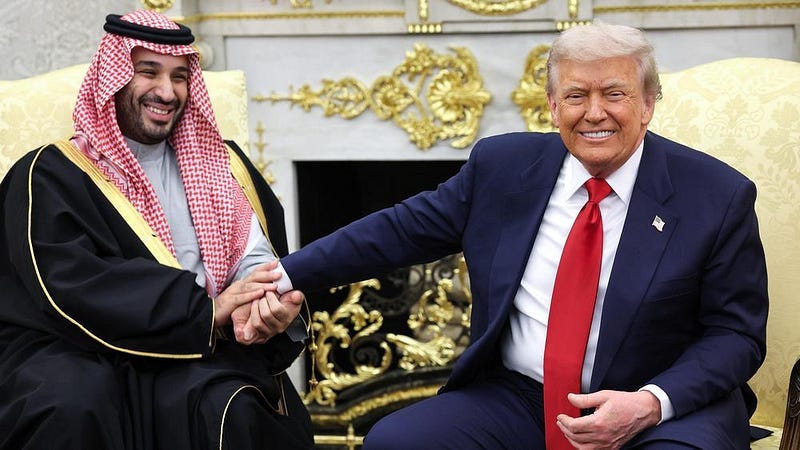
Gulf monarchies spent decades buying American weapons, hosting American troops, purchasing political access in Washington, and publicly aligning with U.S. foreign policy.
When President Donald Trump returned to the White House, the Gulf states rolled out the red carpet: they welcomed him on his first major foreign visit, pumped additional oil onto the market after months of restraint, and pledged trillions of dollars in investments and procurement contracts. But when it mattered most, their lobbying to avert an American war with Iran was outweighed by Israel’s push for one.
The Gulf states were useful to Washington — as bases, as buyers, as political cover — but they were not listened to when the decision that most affected them was being made.
Gulf monarchies have spent the past decade promoting a narrative of economic transformation: away from oil dependency, toward diversified, globally integrated economies. Their “Vision” strategies are based on the premise that they can leverage hydrocarbon wealth, geographic centrality, and expanding domestic markets to attract foreign capital and talent. That premise ultimately rests on the perception of stability.
The conflict has been described as the “end of the narrative” that the Gulf is a permanently safe destination for expatriates, immigrants, and tourists, with analysts suggesting the war has irreversibly shaken the region’s image, exposing a deep-seated fragility beneath the facade of rapid economic transformation.
Saudi Arabia’s 2026 budget was already built on a projected deficit of about $44 billion, or roughly 3.3% of GDP. Oil still accounts for about 54% of state revenues. Each additional month of fighting forces Riyadh to choose between slowing its ambitious megaprojects or increasing borrowing on international markets.
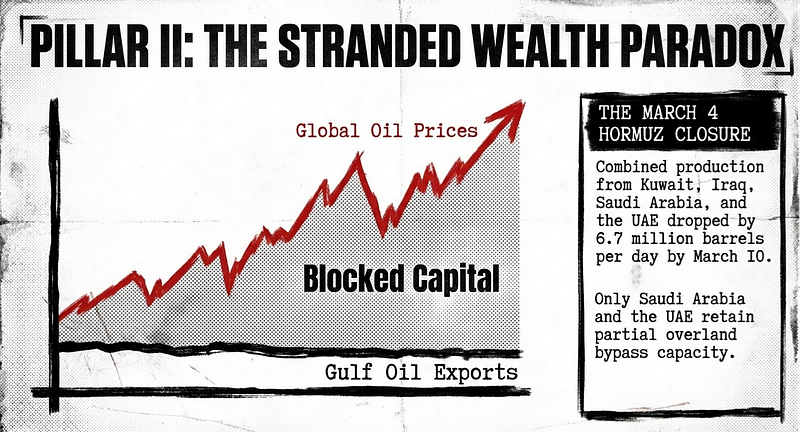
The standard oil-shock logic inverted entirely. Gulf producer states cannot benefit from rising oil prices because they cannot deliver product to market. Saudi Arabia and the UAE retain partial bypass capacity through overland pipeline infrastructure; all other GCC states have none.
Following the closure of the Strait of Hormuz on 4 March 2026, oil and LNG exports were stranded. The oil production of Kuwait, Iraq, Saudi Arabia, and the United Arab Emirates collectively dropped by a reported 6.7 million barrels per day by 10 March. The maritime blockade triggered a grocery supply emergency across GCC states, which rely on the Strait for over 80% of their caloric intake; by mid-March, 70% of the region’s food imports were disrupted.
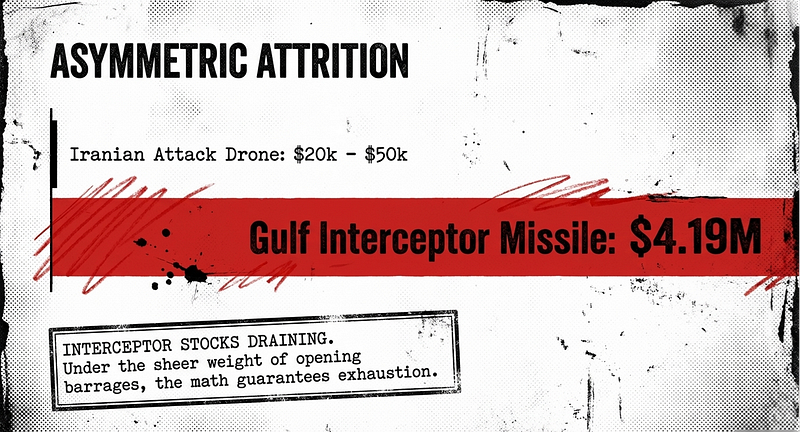
Iran exploited a stark cost asymmetry: its one-way attack drones cost as little as $20,000 to $50,000 per unit, while the interceptors used to destroy them run to $4.19 million apiece. The Gulf states found themselves on the wrong side of that equation, their interceptor stocks running low by the sheer weight of Iran’s opening barrages.
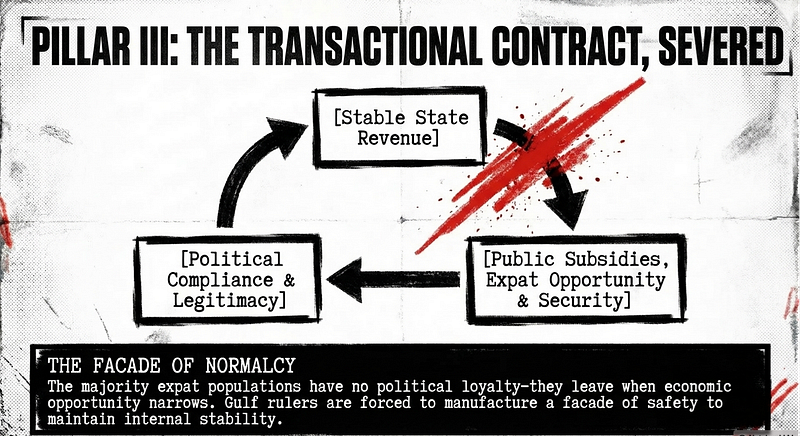
Gulf monarchies derive legitimacy from a transactional arrangement: the state funds public employment, subsidizes goods, guarantees a certain quality of life, and in return the population does not organize politically against the ruling family. This works when revenues are stable. It has not been seriously tested under prolonged disruption.
The social contract between the rulers of the Gulf states and their nationals — and increasingly their majority expat populations — is that the rulers guarantee the livelihoods, comfort, and security of the population in exchange for support.
The Emirates ruling families were quick to reassure the public: on the evening of March 2, Mohammed bin Zayed, the president of the UAE, and Sheikh Hamdan bin Mohammed bin Rashed, the Crown Prince of Dubai and Defense Minister, strolled across the Dubai Mall to insist their country was safe.
That a head of state went to a shopping mall to demonstrate normalcy shows how seriously the legitimacy pressure is being felt.
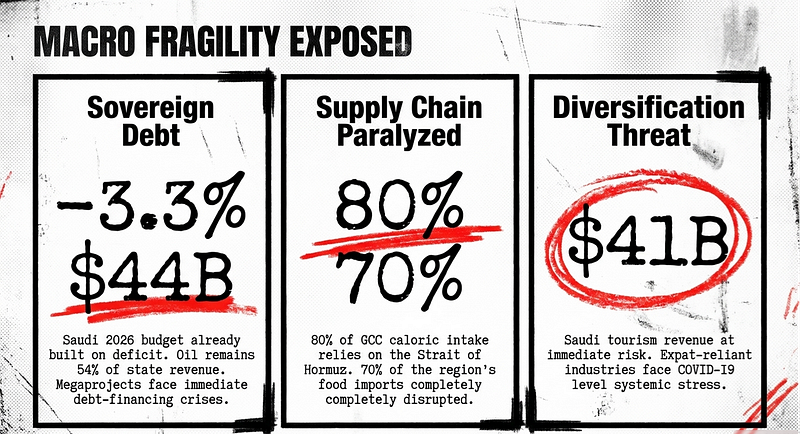
Expat populations — the majority of residents in most Gulf states — have no comparable political loyalty to the regimes that host them. They came for economic opportunity. When that opportunity narrows, they leave. Tourism and aviation sectors in the GCC are likely to experience stress comparable to the COVID-19 pandemic. For Saudi Arabia, this is especially damaging timing, as tourism generated $41 billion in 2024, exceeding petrochemical export revenues for the first time.
Western Framing and What It Leaves Out
Western governments and media have consistently framed this conflict as a confrontation between a rules-based international order and a destabilizing Iran.
Critics of the war, including legal and international relations experts, have described the attacks as illegal under U.S. law, an act of imperialism, and a violation of Iran’s sovereignty under international law.
The United Nations Security Council passed a resolution — condemning Iran’s retaliatory strikes on the Gulf states, not the initial U.S.-Israeli strikes that preceded them.
The economic architecture of the conflict exposes a direct contradiction. The U.S. has imposed enormous costs on many of the same economies it relies on as trading and strategic partners. The damage to allied economies will complicate the coalition politics needed for post-conflict stabilization.
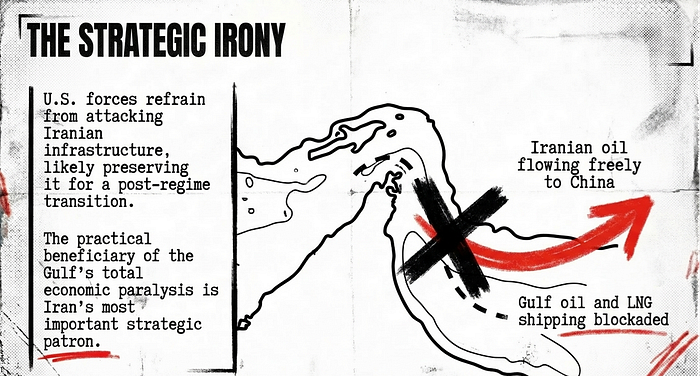
Iran is still exporting oil to China using the Strait of Hormuz — even as it closes the passage to Gulf countries’ shipping. It is possible the U.S. is refraining from attacking Iranian traffic in hopes of preserving the infrastructure that any new Iranian regime would depend upon.
The Gulf states, meanwhile, cannot export their own oil through the same waterway. The practical beneficiary of this arrangement is Iran’s most important strategic patron.
The Gulf states are no longer responding to immediate shock but confronting strategic choices that are exposing their underlying differences.
Three broad positions are now emerging: a restraint-oriented approach, most clearly reflected in Qatar and Oman; an escalation-leaning camp, most prominently represented by the UAE; and states like Saudi Arabia and Kuwait maintaining silence while appearing to quietly facilitate U.S. operations.
These divergences reflect long-standing differences in how Gulf states perceive threats, manage risk, and position themselves within the regional order. Despite their shared institutional framework in the GCC, the Gulf states have rarely operated as a cohesive strategic bloc.
The dismantling or collapse of Iran as a state does not serve the interests of the Gulf region. The lessons from recent conflicts are clear: collapse does not mark the end of a conflict but the beginning of a new phase of chaos, the rise of militias, the emergence of security vacuums, and the cross-border spillover of conflicts.
HR STUDIOS is Creating Award Winning Journalism
Support our workbuymeacoffee.com
What Comes Next
The Gulf states are facing a situation in which the core assumptions of their political existence have been tested simultaneously: U.S. protection failed to shield them, oil revenues are blocked rather than boosted, the image of stability that underpinned their economic diversification push is damaged, and the internal divisions that quiet wealth once managed are now more visible.
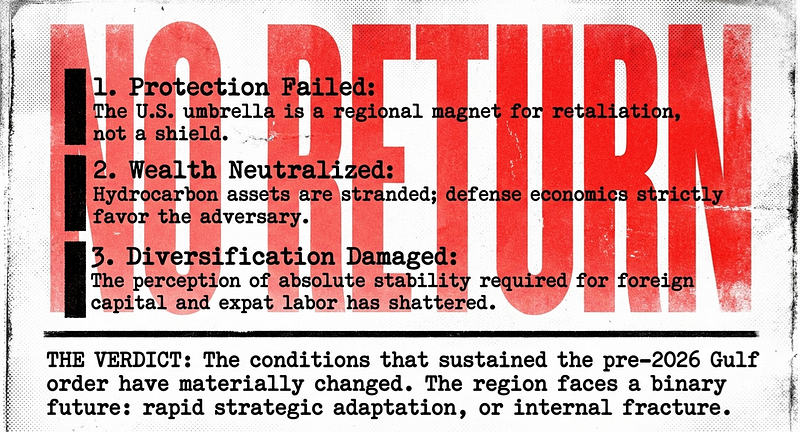
The war has exposed the fragility beneath the Gulf’s economic transformation. Whether that transformation survives intact may depend on how quickly the region adapts to a far more dangerous strategic landscape.
Whether these states reconfigure or begin to fracture internally depends on how long the war continues and whether a coherent post-conflict order emerges. What is not credible is the position that the Gulf can return to exactly what it was before 28 February 2026. The conditions that sustained that order have materially changed.
HR STUDIOS is Creating Award Winning Journalism
Support our workbuymeacoffee.com
bin Salman is so creepy he gave Jeffrey Epstein the creeps
Radioactive contamination from a US led nuclear attack on Iran would eventually contaminate the whole earth. Over decades and centuries toxicity will spread through the soil, the water and the air. A nuclear attack on Iran is an attack on the whole of humanity. Everybody loses.