


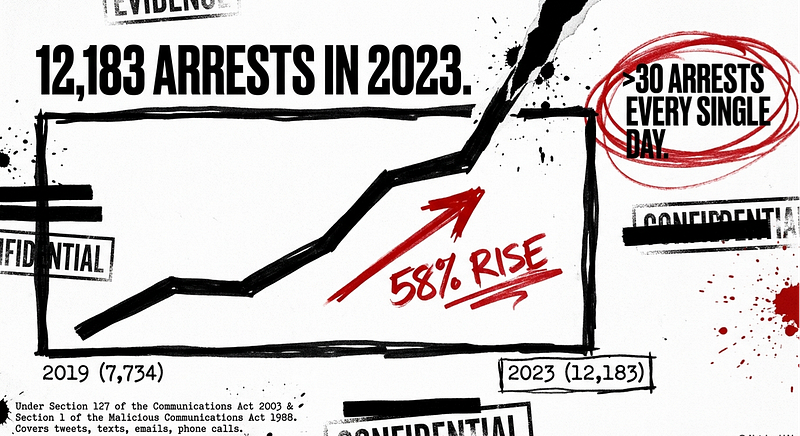
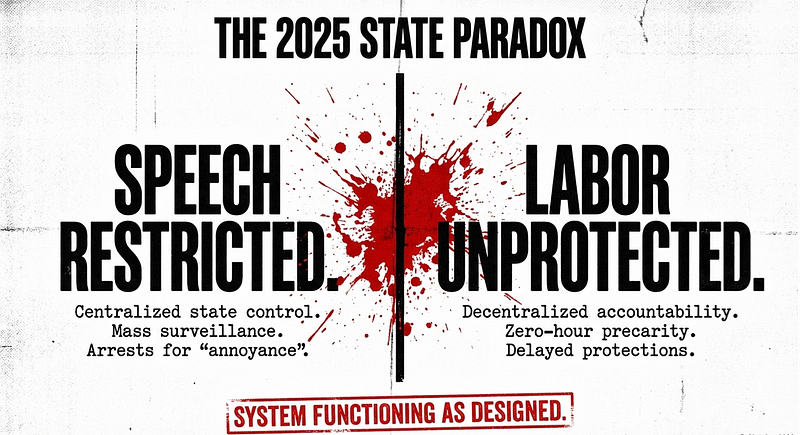
In 2023, police forces across England and Wales made 12,183 arrests under two pieces of communications legislation — Section 127 of the Communications Act 2003 and Section 1 of the Malicious Communications Act 1988. That works out to more than 30 arrests every single day.
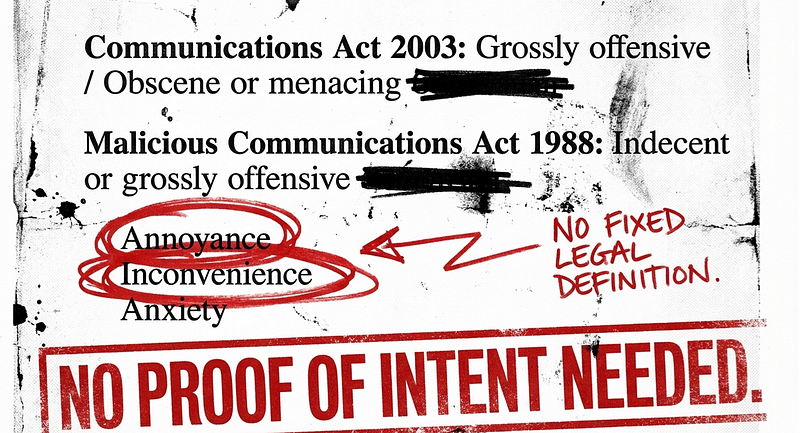
The arrests cover tweets, texts, emails, and phone calls. The legal threshold for arrest includes messages deemed “grossly offensive,” “menacing,” or likely to cause “annoyance,” “inconvenience,” or “anxiety.” These categories have no fixed legal definition.
Between 2019 and 2023, arrests under these laws rose by almost 58%, up from 7,734 in 2019. The numbers have increased every year across that period.
Who Gets Arrested
The legal framework covers a wide range of speech. The Communications Act 2003 covers “grossly offensive” messages. The Malicious Communications Act 1988 covers “indecent or grossly offensive” communications. The Public Order Act covers causing harm or distress, including “stirring up” offences. The Online Safety Act 2023 covers false communication.
Parliamentary debate and Lords Library analysis link the increase in arrests to forces dedicating teams specifically to social media monitoring and laws that criminalise messages causing “annoyance,” “inconvenience,” or “anxiety.”
Most Arrests Do Not Result in Conviction
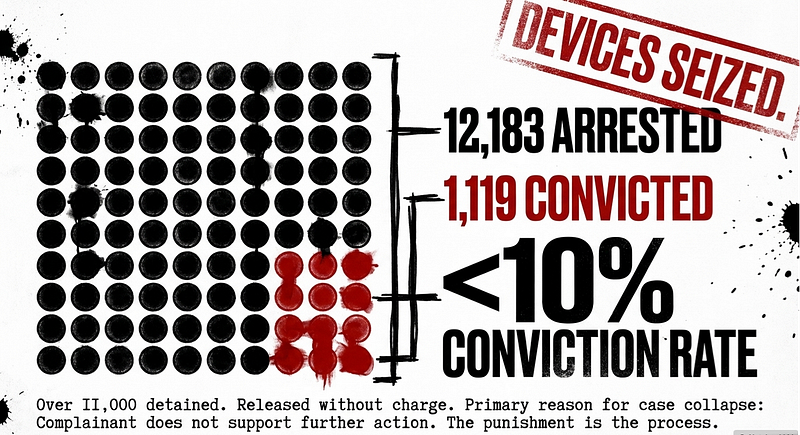
Of those 12,183 arrests in 2023, 1,119 resulted in conviction — fewer than 10%.
More than 11,000 people in that year were arrested, detained, had their devices seized, and were released without conviction. The most common stated reason arrests do not result in conviction is that the complainant does not support further action.
Peers in Parliament noted that the falling conviction rate raises questions about whether enforcement is disproportionate, with implications for freedom of speech.
HR STUDIOS is Creating Award Winning Journalism
Support our workbuymeacoffee.com
The Comparison: UK, China, and Russia
UK (2023): 12,183 arrests under communications laws. Recorded annually. Enforcement is continuous and year-round.
China: Approximately 1,500 arrests from a specific government crackdown on online rumours, running from December 2023 to April 2024 — a time-limited campaign, not an annual figure.
Russia: Approximately 400 cases cited from a 2017 report. A more recent 2023 report documented 882 criminal prosecutions for online posts, following new censorship laws introduced after the invasion of Ukraine.
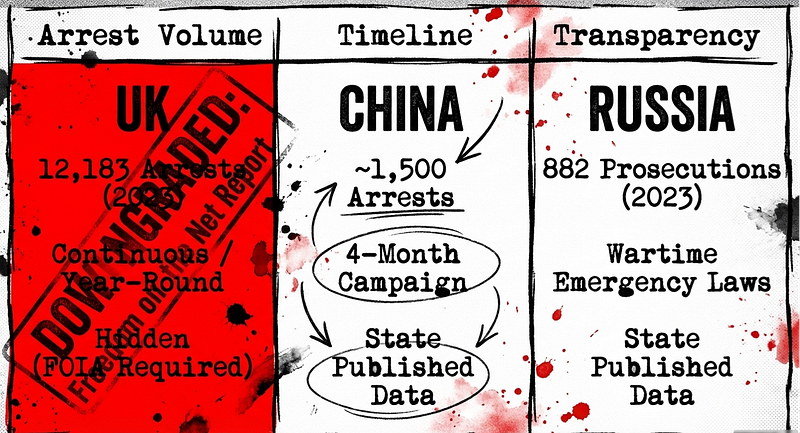
The UK figure is a continuous annual total recorded under laws that have been in operation for decades. The China figure covers a four-month campaign. The Russia figure reflects a specific legislative period following wartime emergency laws. The UK does not publish this data centrally — the 12,183 figure was compiled from Freedom of Information requests to individual forces, covering 35 of England and Wales’s 43 territorial forces. The full national total is not publicly available.
Freedom House’s 2025 Freedom on the Net report downgraded the UK’s score because of the volume of criminal charges, arrests, and convictions for online speech — including speech covered by international human rights standards.
The Online Safety Act
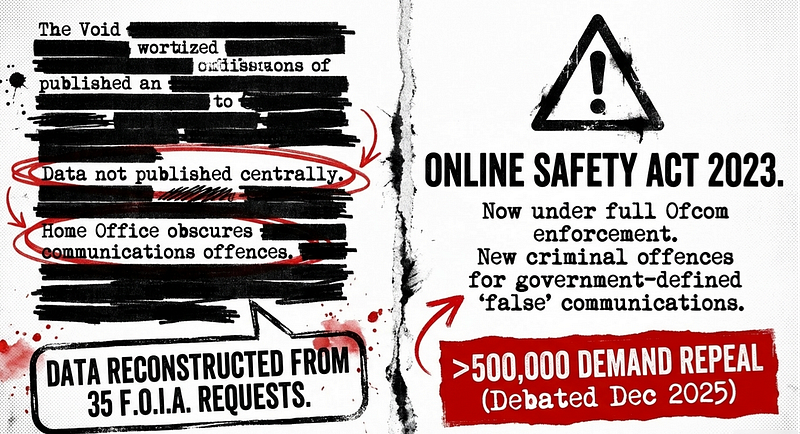
The 2023 arrest figures were recorded before the Online Safety Act 2023 came into full enforcement. The Act added new criminal offences — covering threatening communications and communications the government defines as false — on top of the existing framework. Ofcom enforcement is now active.
A petition calling for the repeal of the Online Safety Act attracted over 500,000 signatures and was debated in Parliament in December 2025.
The Legal Thresholds
Section 127 of the Communications Act covers messages which are “obscene or menacing” and those sent to “cause annoyance, inconvenience or needless anxiety.” The Malicious Communications Act covers communications that are “indecent or grossly offensive.” Neither statute requires proof of intent to harm or evidence that harm occurred.
In the Lords, peers raised the issue of definition creep — where terms like “grossly offensive,” “abusive,” “insulting,” and “false” expand over time to cover a wider range of speech.
The United States in 2025
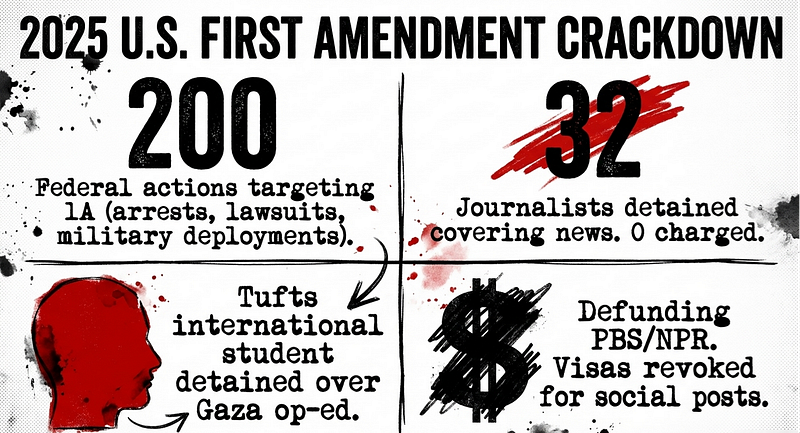
A Free Press investigation catalogued nearly 200 federal actions targeting First Amendment rights in 2025 — including arrests, lawsuits, regulatory actions, and military deployments. An international student at Tufts University was detained after writing an op-ed about the war in Gaza. The Wall Street Journal was sued for reporting on Trump’s ties to Jeffrey Epstein. PBS and NPR faced funding cuts. The State Department revoked visas of foreign nationals for their social media posts.
Press freedom trackers recorded 32 journalists detained or arrested in 2025 while covering news events. None were charged.
Workers’ Rights
In 2025, one in eight young workers in the UK — 12.5% — were on zero-hours contracts, five times the rate of workers aged 25 and over. A record 1.23 million people are on zero-hours contracts in the UK — up 91,000 in a single year. One in three depends on their zero-hours contract as their primary source of income, with no guaranteed hours. 77% are not students. Workers on these contracts typically have no access to redundancy pay, employer sick pay, on-call payments, maternity and parental leave, or pension contributions. Legislation to address this received Royal Assent in December 2025 but does not take effect until 2027.
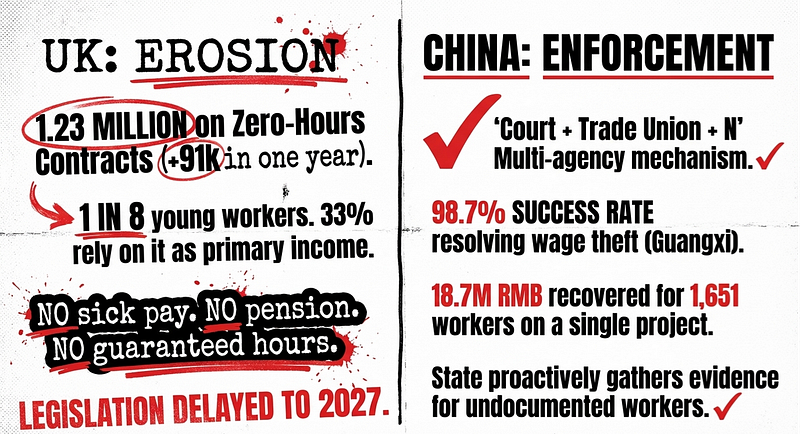
China has established formal multi-agency mechanisms — “Court+Trade Union+N” — to resolve wage theft and labour violations. In Guangxi Zhuang Autonomous Region, these mechanisms resolved 226 out of 229 complaints filed by workers — a 98.7% success rate — recovering nearly 18.7 million RMB in wages for 1,651 workers on a single construction project. In Hubei Province, when eight migrant workers lacked written contracts and had insufficient evidence to claim 50,000 RMB in back wages, a joint court-prosecution-trade union team gathered evidence on their behalf and the employer settled in full.
Data Availability
The UK government does not publish centralised data on communications arrests. The Home Office publishes arrest data by offence group rather than by the specific communications offences. The 12,183 figure was reconstructed through Freedom of Information requests.
HR STUDIOS is Creating Award Winning Journalism
Support our workbuymeacoffee.com
Sources: House of Lords Library · Hansard, Lords debate July 2025 · Freedom House Freedom on the Net 2025 · BritBrief fact-check on comparison data · EFF / Online Safety Act petition · Free Press: First Amendment Timeline 2025 · Work Foundation / Lancaster University · House of Commons Library: Zero-hours contracts

That's really scary ...
https://thebluearmchair.substack.com/p/the-online-safety-act?r=5kmhkr
I don’t think this will work out the way they believe it will