
Study: Since 1950 the Nutrient Content in 43 Different Food Crops has Declined up to 80%
University of Texas analysis finds substantial nutrient losses in vegetables and grains between 1950 and 1999

The broccoli in your fridge is a nutritional ghost.
The wheat in your bread is a hollowed-out husk. The oranges you juice for vitamin C? You’d need to eat eight of them to get what your grandparents got from one.
This is cold, hard, peer-reviewed fact, and it’s happening right now, under our noses, while corporations and governments tell us everything is fine.
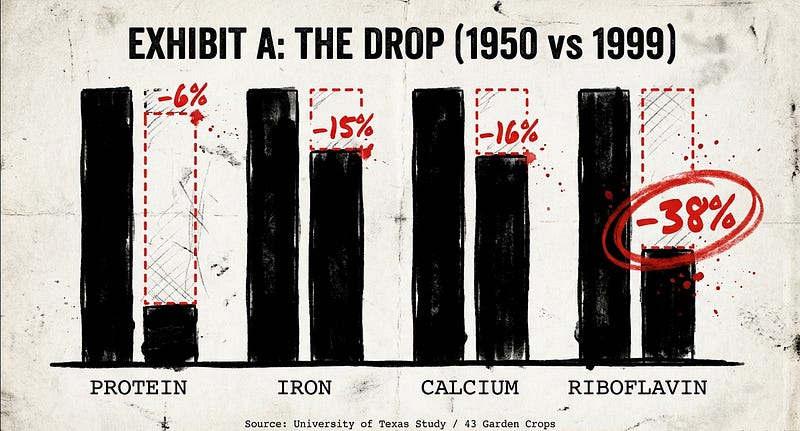
Back in 2004, researchers at the University of Texas dropped a study that should’ve set the world on fire. They dug into USDA nutrient data for 43 garden crops — carrots, spinach, strawberries, the stuff we’re told to eat for health — and compared the numbers from 1950 to 1999.
What they found wasn’t just a decline. It was a nutritional collapse.
Protein? Gone by 6%.
Calcium? 16% vanished.
Iron? 15% wiped out.
But the real gut-punch? Riboflavin (vitamin B2) had plummeted by 38%. And the kicker? The researchers warned that the data was incomplete — because nutrients like magnesium, zinc, and vitamin E weren’t even tracked in 1950. We don’t even know the full extent of what we’ve lost.
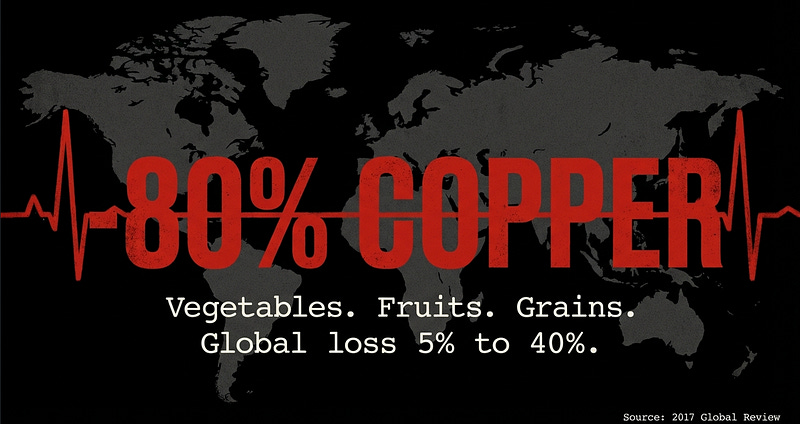
A 2017 global review confirmed that vegetables, fruits, and grains worldwide had lost 5% to 40% of their minerals, vitamins, and protein over the same period. Copper in vegetables? Down a staggering 80%. That’s not a warning sign. That’s a five-alarm fire. And then there’s wheat — the backbone of global diets.
HR STUDIOS is Creating Award Winning Journalism
We create things. things we like.buymeacoffee.com
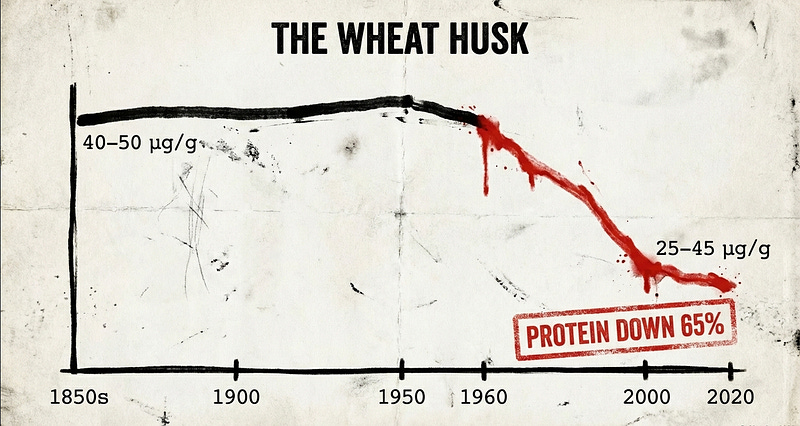
A 2020 study analyzed 166 years of archived samples and found that iron content dropped from 40–50 µg/g in the 1930s to 25–45 µg/g today. Protein? Down by up to 65% in some modern varieties. We’re not just eating less protein. We’re eating far less protein in food that’s supposed to sustain us.
So who’s to blame?
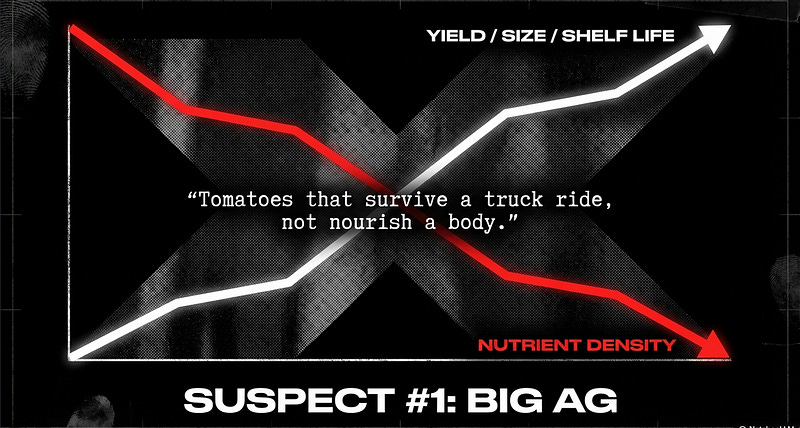
Let’s start with Big Ag’s yield obsession.
Since the Green Revolution, the game has been bigger, faster, cheaper. Breed crops for size, pest resistance, and shelf life — not nutrition. Tomatoes that survive a cross-country truck ride, not nourish a human body. Donald Davis, the lead researcher on the 2004 study, nailed it: “Efforts to breed new varieties of crops that provide greater yield, pest resistance, and climate adaptability have allowed crops to grow bigger and more rapidly, but their ability to manufacture or uptake nutrients has not kept pace with their rapid growth.” We’ve turned food into a commodity. Nutrients were the first casualty.
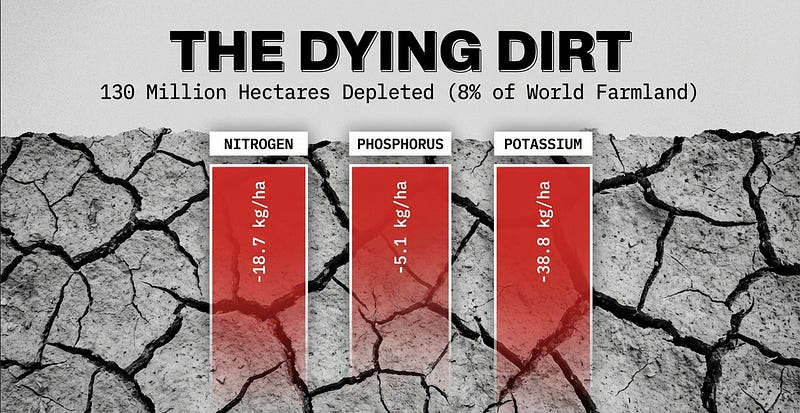
Then there’s soil depletion — the silent, creeping disaster beneath our feet. Globally, soils are losing nutrients at a rate of 18.7 kg of nitrogen, 5.1 kg of phosphorus, and 38.8 kg of potassium per hectare every year. 130 million hectares of cropland — 8% of the world’s farmland — are now nutrient-depleted like this study shows.
And the solution?
Dump synthetic fertilizers on it, which kill soil microbes and reduce plants’ ability to absorb what little nutrients are left as explained here.
But the real kicker? Climate change. Rising CO2 levels don’t just warm the planet — they actively sabotage our food. Studies show that elevated CO2 reduces protein in crops by 10%, iron by 16%, and zinc by 9%. Rice and wheat — staples for half the global population — are hit hardest according to this.
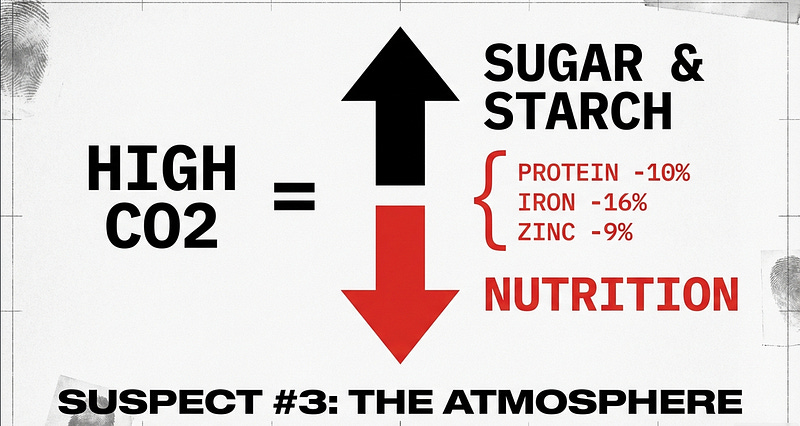
Plants grown in high-CO2 environments prioritize sugar and starch over protein and minerals. So not only is our food less nutritious, it’s more likely to spike your blood sugar. Brilliant.
And the cover-up?
Oh, it’s genius.
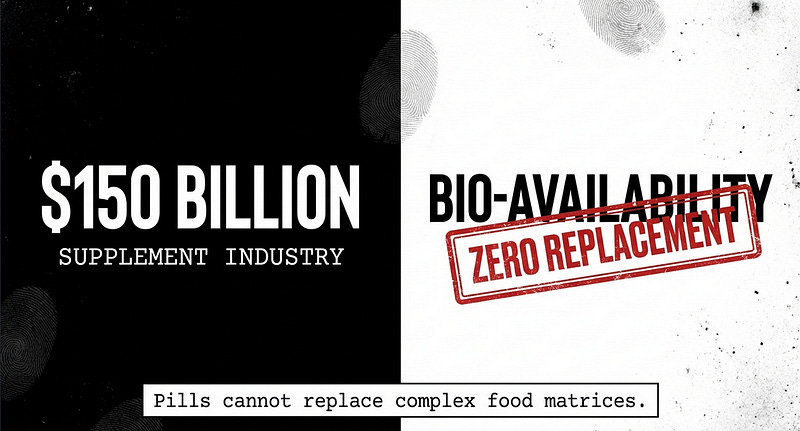
While our food gets emptier, the supplement industry rakes in $150 billion a year as reported here. “Just take a multivitamin!” they say, as if popping a pill can replace the complex, bioavailable nutrients lost in our food. Newsflash: It can’t. Supplements are a band-aid on a gaping, festering wound.
Even the organic movement — supposedly the answer — isn’t immune.
Most “organic” farms still use monocultures and tillage, which deplete soil just as fast as conventional farms.
The difference?
Regenerative organic farms — the ones using no-till, cover crops, and diverse rotations — are proving it’s possible to grow food that’s actually nutritious again. Wheat from these farms has 48% more calcium, 56% more zinc, and 74% more boron than conventional. But good luck finding that wheat in your grocery store.
So what’s the fix? First, stop pretending this is normal. This is not how food is supposed to work.
Second, demand better. Support regenerative farms. Grow your own heirloom varieties. Push for biofortified crops — the kind that HarvestPlus has already proven can reverse iron deficiency in millions.
Third, get angry. This isn’t an accident. It’s the result of decades of short-sighted, profit-driven agriculture that treated soil like dirt and food like a widget.
The future? It’s not pretty if we keep going like this. By 2050, protein in rice and wheat could drop another 20%, deepening the global malnutrition crisis as this study warns. But it doesn’t have to be this way. Regenerative agriculture works. Biofortification works.
We just have to choose food over profits, health over convenience, and real nourishment over empty calories.
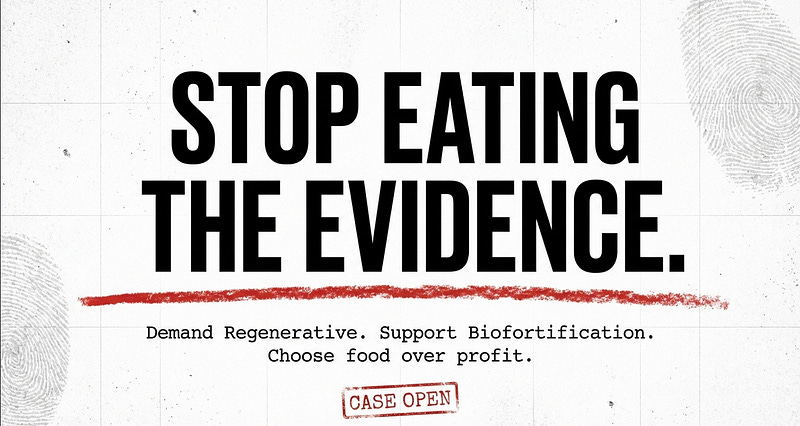
So next time you’re at the store, staring at those sad, shriveled carrots? Remember: This isn’t just bad produce. This is a crime scene. And you’re either part of the solution — or you’re still eating the evidence.
HR STUDIOS is Creating Award Winning Journalism
We create things. things we like.buymeacoffee.com
I feel heard, no one wants to talk about this with me!
We should be recycling human waste, not flushing it away and replacing those nutrients with industrially mined salts. But it's illegal most places to simply want to try.
A nutrient that sent me into a tailspin is B12. Defined as a necessary nutrient, yet nearly everyone in the West (and perhaps globally) is supplemented, either directly or via animal supplementation, with a vitamin produced in vats by bacteria that require cobalt, which is dependent on mining. It's not one that people worry a lot about because it takes a long time without it to have noticeable effects, and the argument is that you can easily get it from animal products. See the Vital Farms backlash: even free range, organic, put whatever label you want on it, is supplemented this way. Livestock have not been able to accumulate B12 naturally in several generations.
My point is that all of our proposed solutions, even organics and no-till farming, are not safe from this -- they still require remineralizing our soil, and how do we achieve that at a global scale without extractive mining? Cobalt is well known for being one of the worst in terms of human rights issues.
We can't just keep moving the extraction somewhere we can't see it, and I feel like that's a lot of the mainstream response. Perhaps I have just not stumbled on the right research yet. Agriculture is heavily mythologized and regulated, and it's hard to find niche information.
I am newish to Substack and looking for people to follow who are actively working on this and urban solutions. Drop your recommendations in the comments, please! :)
Damn…this is disturbing. My hope: may every human be given enough space to grow their own fresh food!