
How Microplastics and a Destabilizing Magnetosphere Are Accelerating the Sixth Mass Extinction
A long-form analysis grounded in peer-reviewed science, 2021–2026

There is a particular kind of institutional comfort that comes from telling the public not to panic.
When the South Atlantic Anomaly began expanding in satellite data, the reassurance was swift: this is within the range of natural variation.
When microplastics began appearing in human blood and organs, the response was measured: more research is needed.
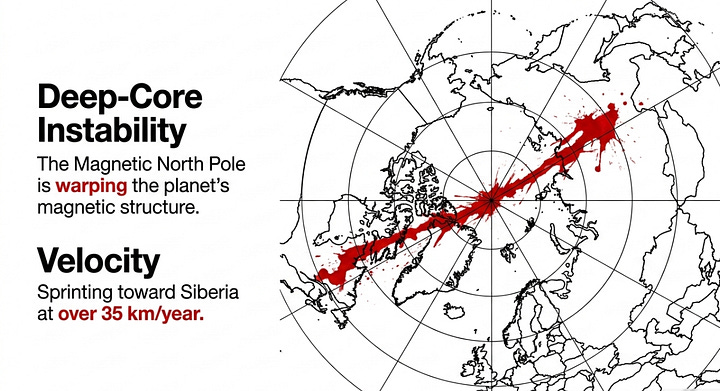
When the magnetic north pole accelerated toward Siberia at speeds unprecedented in the 190 years since we first located it, scientists released a model update and said the situation was being monitored.
These responses are not wrong, exactly. They reflect genuine scientific caution about overstatement, a caution earned through centuries of embarrassing predictions.
But there is another kind of error less frequently named: the failure to integrate. The failure to ask what it means when a dozen individually “normal” or “within natural range” processes are occurring simultaneously, in the same century, stacked on top of each other like geological strata compressed into a single human lifetime.
This essay is an argument for integration. It draws on peer-reviewed research published between 2021 and 2025 — some of it still contested at the margins of its own field — to construct a thesis that is not conspiratorial or mystical but simply systemic: Earth is currently experiencing a convergence of destabilizing processes, two of which have received far less combined attention than they deserve.
The first is the measurable, accelerating weakening of the planet’s magnetic field. The second is the explosive proliferation of synthetic microplastic particles through every biological system on Earth. Considered separately, each is alarming.
Considered together, as co-occurring stressors on the same living systems during the same geological moment, they begin to look less like parallel emergencies and more like the compound architecture of a mass extinction event.
We have a name for the current extinction crisis: the Sixth. We have assigned it causes: habitat loss, climate change, invasive species, overhunting, ocean acidification.
These causes are real and well-documented. But the conversation has remained largely siloed — climate scientists talk to climate scientists, toxicologists to toxicologists, geomagnetists to geomagnetists. The synthesis that this moment requires is happening too slowly. This essay is an attempt to accelerate it.
Part One: Revising the Consensus — The Adams Event and What It Means Now
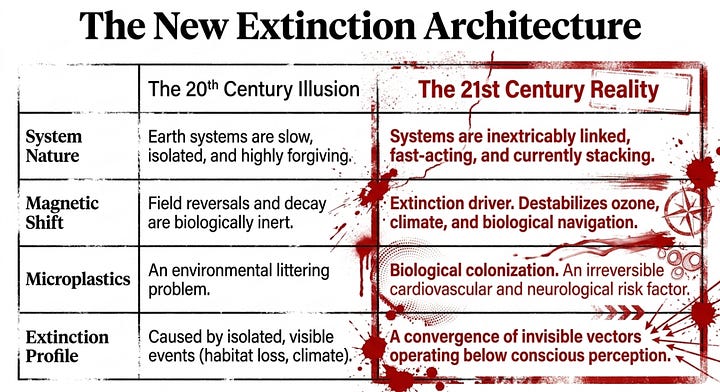
For most of the twentieth century, the working assumption in geophysics was that geomagnetic changes — including reversals and excursions of the magnetic poles — were biologically irrelevant. The field strength varied, the poles wandered, and life continued. The sheer scale of geological time seemed to offer reassurance: reversals take thousands of years to complete, and nothing in the extinction record suggested a clean causal link to magnetic events.
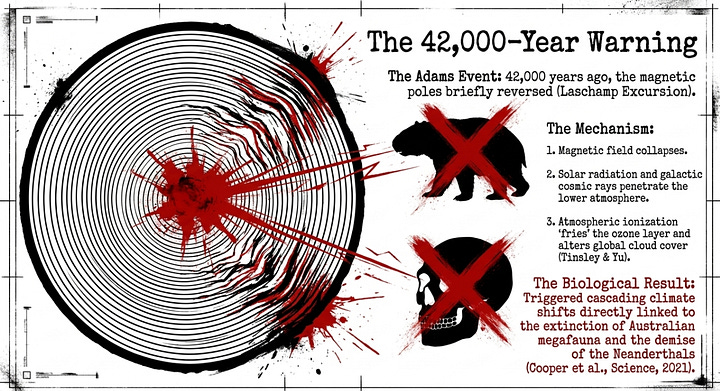
That assumption began to crack with a paper published in Science on February 19, 2021. Authored by Alan Cooper, Chris Turney, and colleagues from UNSW Sydney and the South Australian Museum, the study — “A Global Environmental Crisis 42,000 Years Ago” — presented something the field had not previously had: a precise, dateable, cross-correlated record of what actually happened to the Earth’s environment during a period of severe magnetic field weakening.
The event in question was the Laschamp Excursion, a geomagnetic episode occurring approximately 41,000–42,000 years ago in which the magnetic poles briefly reversed. What made the Cooper study different from previous investigations was its methodology.
Using carbon dating from ancient kauri trees in New Zealand, researchers correlated shifts in climate patterns, large mammal extinctions, and changes in human behavior just before and during the Laschamp excursion — and it was the first study to directly link a magnetic pole reversal to large-scale environmental changes.
The kauri trees are remarkable natural archives. Their rings encode atmospheric radiocarbon concentrations with annual precision, which means researchers could track, year by year, how the atmosphere changed as the magnetic field collapsed.
What they found was not subtle. Using the ancient trees, scientists could measure and date the spike in atmospheric radiocarbon levels caused by the collapse of Earth’s magnetic field, and they found the ionized air had “fried” the ozone layer, triggering a ripple of climate change across the globe.
The team named the broader event the Adams Transitional Geomagnetic Event — a nod to Douglas Adams, given that the answer to the universe turned out to involve the number 42,000. But the findings were anything but a joke.
The study tied these events to the extinction of megafauna across mainland Australia and Tasmania, including species like the giant wombat Diprotodon and the giant kangaroo Procoptodon goliah. Simultaneously, in Europe, the archaeological record shows a dramatic change in human behavior: retreat into caves, the sudden proliferation of cave art, significant cultural disruption. The Neanderthals, already stressed, did not survive this period.
The mechanism Cooper’s team proposed is what makes this study genuinely paradigm-shifting. It was not simply that the magnetic field weakened. It was that the weakening allowed a dramatically increased flux of solar radiation and galactic cosmic rays to reach the lower atmosphere, triggering chemical cascades that damaged the ozone layer, altered global cloud cover, shifted precipitation patterns, and ultimately destabilized the climate systems that megafauna had evolved to navigate.
The combination of a weak magnetic field and a decrease in solar output at the same time “created the perfect storm” of climate and broader environmental changes, placing major stress on megafauna populations.
Critics have correctly noted that the Laschamp Excursion involved a far more dramatic field weakening — effectively a 95% reduction in field strength — than what we currently observe.
The current global average weakening, measured over the past 200 years, is approximately 9–10%. This is not the same magnitude of event. A careful reading of Cooper et al. does not allow us to claim otherwise.
But the study’s import is not that we are already at Laschamp levels. Its import is that the 20th-century consensus — that field weakening is biologically inert — is no longer scientifically defensible.
The mechanisms by which a weakened field degrades ozone chemistry, amplifies cosmic ray flux, and destabilizes atmospheric electrical balance are now documented. The question is not whether those mechanisms exist.
The question is at what point on the decay curve they become ecologically significant — and whether, given everything else happening simultaneously, the threshold is lower than we assumed.
Part Two: The Living Instrument — What the Swarm Satellites Are Telling Us
If Cooper et al. established the historical precedent, the European Space Agency’s Swarm mission is providing the real-time data. Launched in 2013 as a constellation of three satellites tasked with mapping Earth’s magnetic field with unprecedented precision, Swarm has fundamentally changed what we know about the pace and geography of the current weakening.
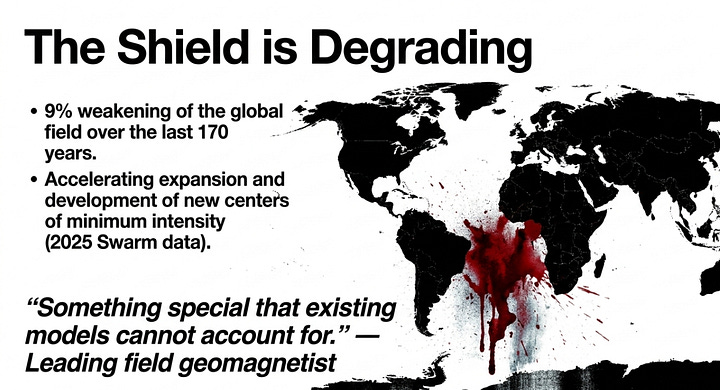
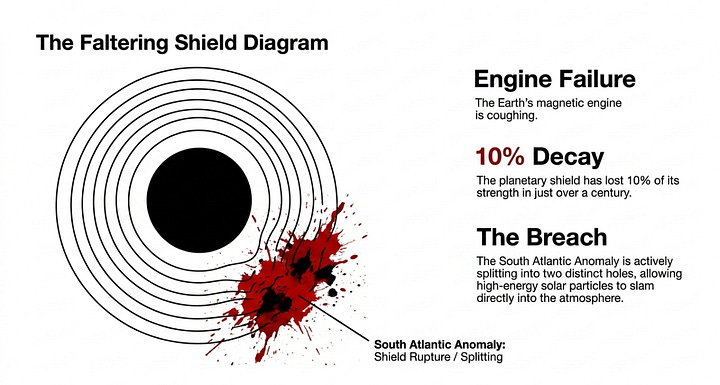
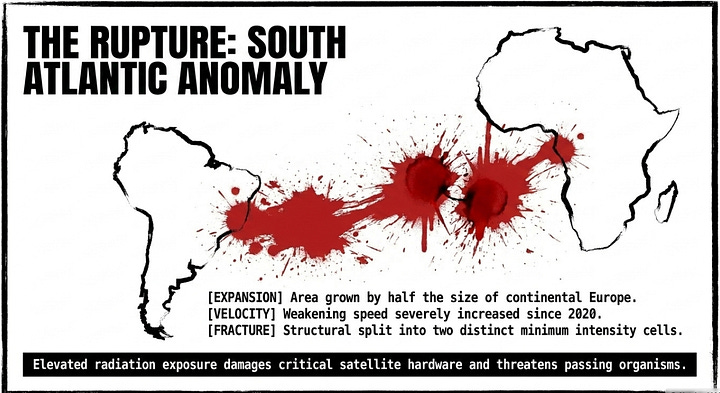
Over the last 200 years, the magnetic field has lost around 9% of its strength on a global average, and a large region of reduced magnetic intensity has developed between Africa and South America — known as the South Atlantic Anomaly. That figure alone would be notable. But the Swarm data has added a layer of alarm that the global average obscures: the weakening is not uniform, and in some regions, it is accelerating.
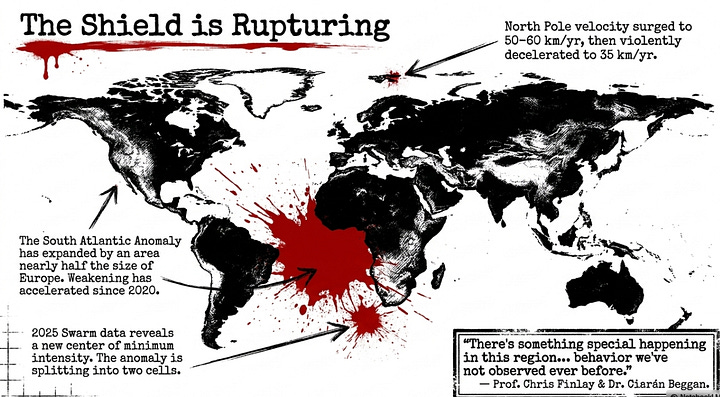
Studying the Anomaly for 11 years, from 2014 to 2025, Swarm’s three satellites showed that the South Atlantic Anomaly had expanded by an area “nearly half the size of continental Europe,” and the speed of the area’s weakening has increased since 2020, with different parts of the anomaly changing at different rates.
The lead author of the 2025 Swarm study, Professor Chris Finlay of the Technical University of Denmark, described the regional differentiation in terms that suggest something structurally unusual is occurring beneath the surface: “The South Atlantic Anomaly is not just a single block. It’s changing differently towards Africa than it is near South America. There’s something special happening in this region that is causing the field to weaken in a more intense way.”
Over the past five years, a second centre of minimum intensity has emerged southwest of Africa, indicating that the South Atlantic Anomaly could split up into two separate cells — a structural complexity that simple dipolar models of the field are unable to account for.
What does this mean physically? The South Atlantic Anomaly is, at its simplest, a rupture in the planet’s electromagnetic armor. Satellites passing over the region face higher doses of incoming radiation, which can lead to malfunctions or damage to critical hardware, and even blackouts. That is the technological consequence.
The biological consequence is more diffuse but potentially more consequential: the region over which organisms — including migratory species, marine life near the surface, and humans — are exposed to elevated cosmic radiation is growing, measurably, year by year.
Meanwhile, the magnetic north pole has embarked on a trajectory that has no recorded precedent. Between 1990 and 2005, magnetic north accelerated from its historic speed of 0–15 km per year to a speed of 50–60 km per year.
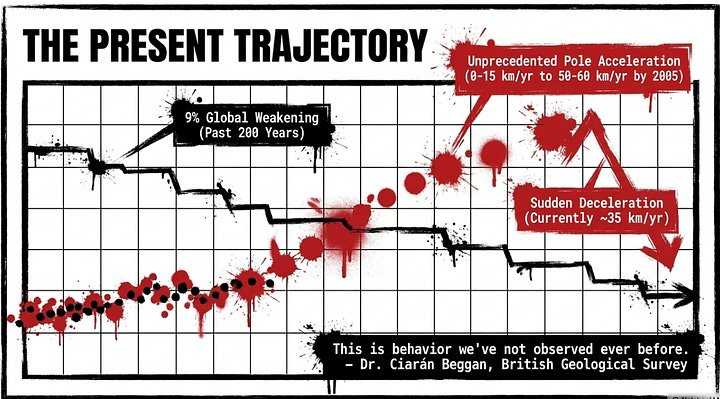
This acceleration was so dramatic that by 2019, the fluctuations had deviated so far from the prior model that scientists updated the World Magnetic Model a year early — a historically unprecedented step. More recently, the pole has decelerated to approximately 35 km per year — what one scientist called “the biggest deceleration in speed we’ve ever seen.” Scientists cannot explain why it accelerated, and they cannot explain why it slowed.
As Dr. Ciarán Beggan of the British Geological Survey put it: “This is behavior we’ve not observed ever before. It makes forecasting magnetic field change more difficult.”
The unpredictability is itself the signal. A planetary system exhibiting behavior that has no precedent in the entirety of the modern observational record is not exhibiting “normal variation.” It is exhibiting instability. And instability, in complex systems, has a tendency to compound.

Part Three: The Mechanism — How a Weakened Shield Destabilizes the Atmosphere
The Cooper study established historical precedent. The Swarm data establishes current measurement. But for the argument to hold that magnetic weakening constitutes a meaningful contribution to current ecological stress, there must be a plausible physical mechanism connecting field strength to biological consequences. This is where the science becomes both more contested and more interesting.
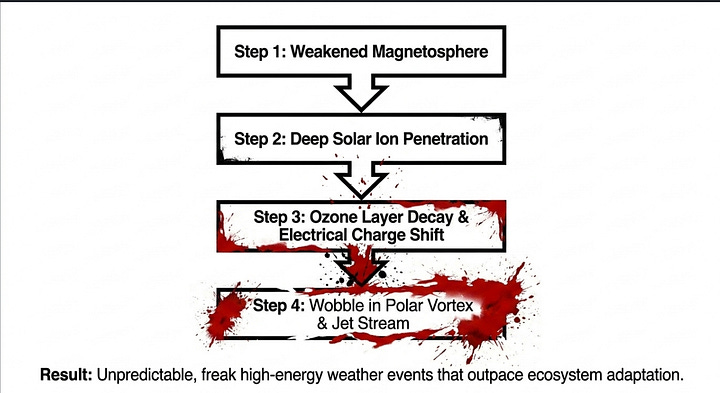
The most direct pathway is through galactic cosmic rays. Earth’s magnetic field acts as a deflector for high-energy charged particles streaming from both the sun and from deep space. When field strength decreases, more of these particles penetrate into the lower atmosphere. This is not speculative: it is measurable and has been measured. The question is what those particles do once they arrive.
Research by Brian Tinsley of the University of Texas and colleagues explored one pathway: the relationship between atmospheric ionization — driven by cosmic ray flux — and cloud microphysics. The proposed chain is as follows.
Increased cosmic ray penetration ionizes air molecules in the lower troposphere.
Ionized air acts as a seed for aerosol and cloud condensation nuclei.
Altered cloud nucleation changes cloud cover, cloud reflectivity, and the distribution of atmospheric electricity.
These changes in atmospheric electricity create pressure gradients that can influence large-scale circulation patterns, including the jet streams. The full chain remains a hypothesis requiring further empirical validation, but it provides what critics of the magnetic-climate link said was missing: a physical mechanism, not merely a correlation.
The more directly documented pathway is through ozone chemistry. This is not speculative at all — it is what Cooper’s team simulated and what the historical record from the Laschamp event appears to confirm. Solar energetic particles and galactic cosmic rays, when they penetrate to stratospheric altitudes, catalyze nitrogen oxide chemistry that destroys ozone molecules.
A weakened magnetic field allows more of these particles to penetrate to these altitudes.
The result is measurable ozone depletion in the polar regions during geomagnetic storms — a phenomenon that has been documented with modern instrumentation during significant solar events. The Laschamp record suggests that during a prolonged period of extreme field weakness, this process can shift from a storm-by-storm event to a persistent structural feature of the atmosphere.
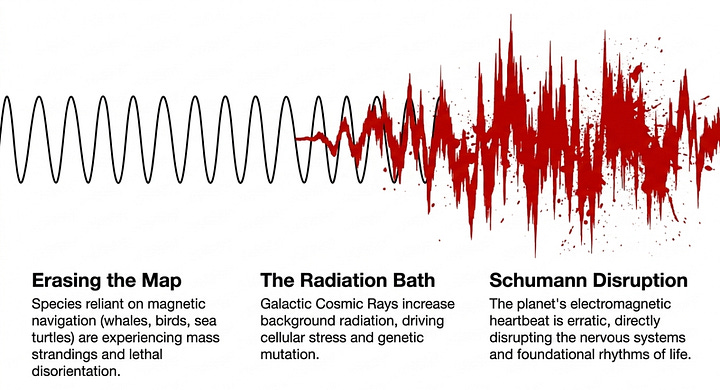
We are not at Laschamp levels. But the direction of travel is documented, the mechanism is understood, and the current field is measurably weaker than it was 200 years ago, weaker than it was 50 years ago, and weaker than it was last decade in the South Atlantic. The accumulation of “not yet critical” data points in a consistent direction deserves more than reassurance.
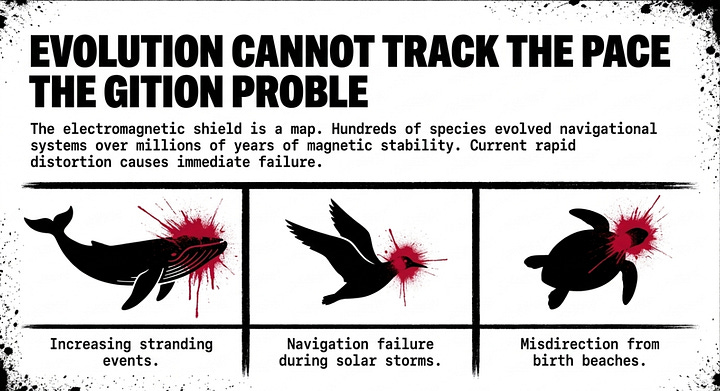
The biological consequences for navigating species are more immediate. The Earth’s magnetic field is not merely a shield — it is a map. Hundreds of species use magnetoreception to orient themselves across vast distances: sea turtles returning to their birth beaches, migratory birds crossing continents and oceans, whales navigating ocean basins, salmon returning to their rivers.
These organisms evolved their navigational systems over millions of years of magnetic stability.
The current rate of change — pole movement, regional field distortion, anomaly expansion — is happening on a timescale that evolution cannot track.
The disorientation of magnetosensitive species, already documented in increasing rates of whale strandings, bird navigation failures during solar storms, and sea turtle misdirection events, will only intensify as the field continues to warp.
Part Four: The Synthetic Invasion — Microplastics and the Colonization of Biology
While the magnetosphere weakens from without, a different kind of systemic assault is occurring from within. Since the post-war explosion of plastic production, the planet has generated approximately 10 billion metric tons of synthetic polymer material.
The majority of this has not been recycled. It has not biodegraded. It has broken — broken into smaller pieces, and then smaller still, and then smaller again, into fragments now routinely measured in micrometers and nanometers, and those fragments have entered every biological system on Earth.
The presence of microplastics in marine environments has been documented since the 1970s.
Their presence in terrestrial soils, freshwater systems, the Arctic snowpack, and high-altitude cloud formations has been established more recently. But the findings of 2023–2025 represent a qualitative shift in how the scientific community understands the scope of what is occurring.
Microplastics are no longer an environmental problem. They are a biological event.
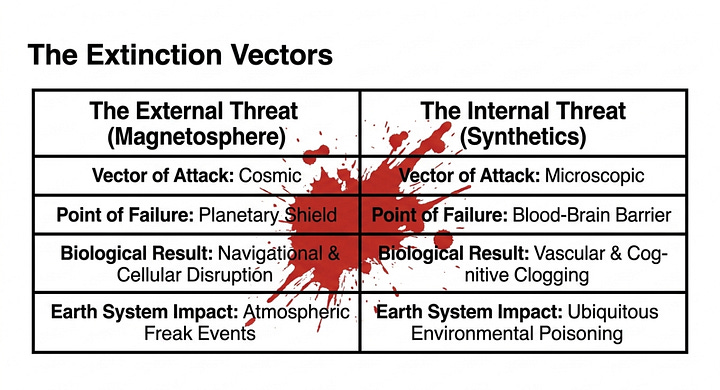
Studies have found micro- and nanoplastics (MNPs) in human lungs, placentas, blood vessels, and bone marrow. A 2024 study found evidence that MNPs can pass through the blood-brain barrier, a selective filter that controls what can enter the brain from the bloodstream.
The blood-brain barrier is, by design, one of the most formidable biological defenses in vertebrate physiology. It exists precisely to prevent foreign materials from reaching the brain’s neural tissue. Its breach by synthetic polymer particles — particles that have existed in their current form for less than a century — represents a failure of a biological defense mechanism that evolved over hundreds of millions of years.
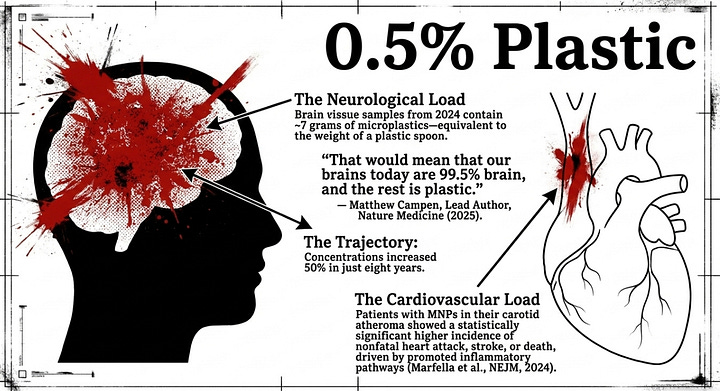
The quantitative data from the 2025 Nature Medicine paper by Nihart, Campen, and colleagues is among the most disturbing in the recent literature.
Samples collected in 2024 contained about 50% more microplastics than those taken eight years earlier, with brain tissue samples holding approximately 7 grams of microplastics — the equivalent of a plastic spoon in weight. The lead author, Matthew Campen of the University of New Mexico, framed it with devastating bluntness: “That would mean that our brains today are 99.5% brain, and the rest is plastic.”
Research from the University of São Paulo and Freie University Berlin, examining samples from 15 deceased Sao Paulo residents, identified plastic fibers and particles in the olfactory bulb in 8 of 15 samples, with polypropylene as the most common polymer detected.

The olfactory bulb’s significance here is not merely anatomical. The olfactory pathway — the channel connecting the nasal cavity to the brain — is one of the few routes that bypasses the blood-brain barrier entirely, offering microplastics a structural highway directly into central nervous system tissue.
Evidence from maternal exposure studies further underscores the vulnerability of developing organisms: nanoplastics ingested by pregnant animals have been shown to cross both the intestinal and placental barriers, entering fetal circulation and subsequently detected in various fetal organs, including the brain.
This transplacental transfer means we are not merely talking about a generation currently being exposed. We are talking about children born with microplastics already present in their neural tissue — a contamination baseline that shifts upward with each passing year of increasing environmental concentration.
The cardiovascular data is equally alarming and, unlike some of the neurological findings, is already appearing in major clinical journals. The 2024 study by Marfella and colleagues, published in the New England Journal of Medicine, examined patients undergoing carotid endarterectomy — surgical removal of arterial plaque — and tested the removed tissue for the presence of micro- and nanoplastics.
Patients with MNPs present in the atheroma sampled from their carotid artery had a statistically significant higher incidence of a composite of nonfatal heart attack, nonfatal stroke, or death during follow-up, and higher concentrations of inflammatory markers associated with atherosclerosis were noted in those with MNPs detected in their carotid atheroma.
It should be noted, as scientific honesty requires, that a letter published subsequently in the NEJM raised concerns about potential sample contamination in the Marfella study, noting the absence of pre-analytical anti-contamination procedures and the high risk of intraoperative plastic exposure in a surgical environment.
This is a legitimate methodological concern and the finding awaits independent replication. But it has been noted in Nature Reviews Cardiology that in patients with carotid artery disease, the presence of microplastics and nanoplastics in carotid plaque is associated with an increased risk of death or major cardiovascular events compared with patients in whom they were not detected — and the biological plausibility of the mechanism is supported by extensive preclinical data showing MNPs promote inflammatory pathways in endothelial cells, accelerate atherosclerotic progression, and impair vascular function.
The JACC framing was blunt: given the in vivo and in vitro evidence suggesting MNPs produce cardiotoxic effects, are we now forced to consider MNPs as a novel risk factor for cardiovascular disease? The answer, based on current data, appears to be yes.
Part Five: The Compounding — Why Simultaneous Stressors Are Not Simply Additive
To understand why these two phenomena — a weakening magnetosphere and microplastic biological invasion — matter more in combination than either does alone, it is necessary to understand something about how extinction events actually work.
The Sixth Mass Extinction is often discussed as if it has a single cause — climate change, or human land use, or one of the other primary drivers that dominate the literature. But paleontologists who study the previous five mass extinctions have consistently found that they are not single-cause events. They are convergence events.
The end-Permian extinction, the most severe in Earth’s history, involved the simultaneous action of massive volcanic emissions, ocean anoxia, acidification, and temperature spike.
The end-Cretaceous event famously involved an asteroid impact, but also occurred during a period of already-elevated volcanic activity and ecological stress that had been running for thousands of years before the impact. The asteroid did not cause the extinction alone. It was the final perturbation delivered to a system already operating near its stress threshold.
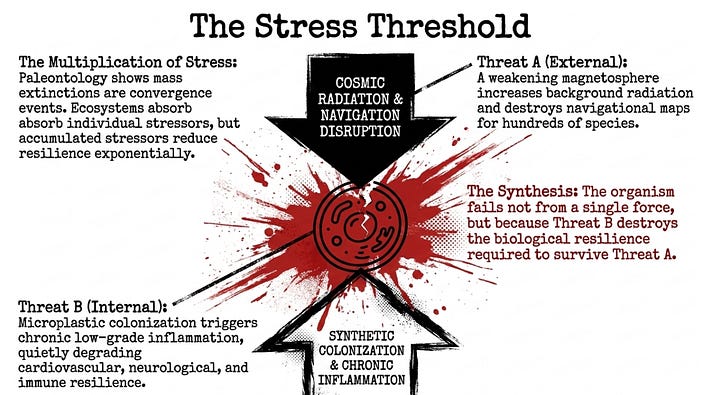
The concept that matters here is what ecologists call the “stress threshold effect” — the observation that ecosystems and organisms can absorb individual stressors with resilience, but the accumulation of stressors reduces that resilience exponentially, not linearly. A coral reef bleaches under heat stress but recovers. Under heat stress plus acidification, recovery takes longer. Under heat stress, acidification, plus pollution, the reef fails. The individual stressors were survivable in isolation. Their combination was not.
Apply this framework to the current situation. Migratory species are already under pressure from habitat fragmentation and climate-altered seasonal timing. Now add the navigational disruption caused by a warping magnetic field that their magnetosensory systems were not evolved to track.
The additive effect on navigation failure rates, reproductive success, and population connectivity is not simply the sum of two pressures — it is a multiplication, because each pressure degrades the organism’s capacity to respond to the other.
Similarly: human immune function is already compromised in populations exposed to chronic stress, air pollution, and processed food systems. Now consider what it means for that immune function to be further impaired by the presence of microplastic particles in brain tissue, in arterial walls, in fetal organs, triggering chronic low-grade inflammation that quietly degrades cardiovascular and neurological resilience over decades.
The organism carrying this synthetic load is less able to respond to every other stressor it encounters — including, potentially, the elevated radiation exposure associated with a weakening magnetosphere.
The connection between elevated radiation exposure and DNA damage is not speculative. It is the foundational logic of oncology and radiation safety. The magnetosphere’s role in protecting surface life from cosmic radiation is real and measurable.
A 9–10% reduction in global field strength, distributed unevenly with regional areas of much steeper decline, translates to a measurable increase in background radiation dose. For individual organisms, this may be trivial.
For populations already experiencing elevated mutation rates from chemical exposures — including the endocrine-disrupting and potentially mutagenic chemical additives that leach from plastic particles — the additive radiation exposure shifts the population genetics of every exposed species in directions that are difficult to predict but unlikely to be neutral.
Part Six: The Biological Record — What the Field’s Decline Has Already Done
Cooper et al. did not emerge from a vacuum. The 2021 Science paper was a capstone to years of accumulating evidence that geomagnetic events have biological fingerprints. A 2024 article in Scientific American reported on research linking a period of extreme magnetic field weakness approximately 565 million years ago — during the Ediacaran-Cambrian transition — to one of the most significant restructurings of complex life in Earth’s history.
Researchers studying paleointensity from that period determined the field was approximately 10 times weaker than Earth’s modern magnetosphere, and some scientists have surmised this contributed to a major extinction of Ediacaran fauna.
The Ediacaran extinction eliminated virtually all the complex multicellular organisms that had pioneered animal body plans. What replaced them was the Cambrian explosion — an extraordinary diversification of life into new ecological niches.
One interpretation of this sequence is that periods of geomagnetic instability, rather than simply causing extinction, restructure the selective landscape: they eliminate specialists and stress-sensitive lineages while creating opportunities for organisms with greater genetic variability and environmental flexibility.
If that interpretation is correct, it is cold comfort for the current moment. Specialists dominate modern ecosystems. The entire architecture of industrial agriculture is built on narrowly adapted genetic lines — wheat varieties, livestock breeds, aquaculture species — selected for productivity in stable conditions, not for resilience to electromagnetic and radiation stress.
The wild biodiversity that might provide the adaptive reservoir for survival through a period of magnetic instability has been catastrophically reduced by 200 years of habitat destruction. We have, in effect, maximally increased our vulnerability to exactly the kind of stress that the geomagnetic record says periodically restructures the biosphere.
Part Seven: The Frontier — What 2021–2025 Science Has Changed
Ten years ago, a synthesis argument linking magnetic field decline and microplastic contamination to extinction risk would have been dismissed as alarmism with no scientific scaffolding. The scaffolding now exists, and it is worth being explicit about what has changed.
Prior to Cooper et al. (2021), the standard scientific position was that geomagnetic excursions had no demonstrated link to biological outcomes. That position is now untenable. The study established, for the first time in the refereed literature, a direct, mechanistically plausible, temporally precise correlation between field weakening, atmospheric chemistry disruption, and large mammal extinction. The authors themselves, including Cooper, have noted that the current rate of field weakening — roughly 9% over 170 years, with recent acceleration in key regions — may be signaling an approaching excursion.
Prior to the 2024 NEJM paper by Marfella and colleagues and the 2025 Nature Medicine paper by Nihart and Campen, microplastics were widely understood as an environmental contaminant of concern but not as an established cardiovascular and neurological risk factor in humans. Those papers moved the conversation from ecological concern to clinical emergency — establishing presence in human brain tissue at escalating concentrations and association with measurable cardiovascular outcomes.
Prior to the 2025 Swarm data published in Physics of the Earth and Planetary Interiors, the South Atlantic Anomaly was understood as a stable if unusual feature of the geomagnetic landscape. The Swarm paper established that it is not stable: it is expanding, accelerating in some regions, developing new centers of minimum intensity, and behaving in ways that the field’s leading geomagnetist described as “something special” that existing models cannot account for.
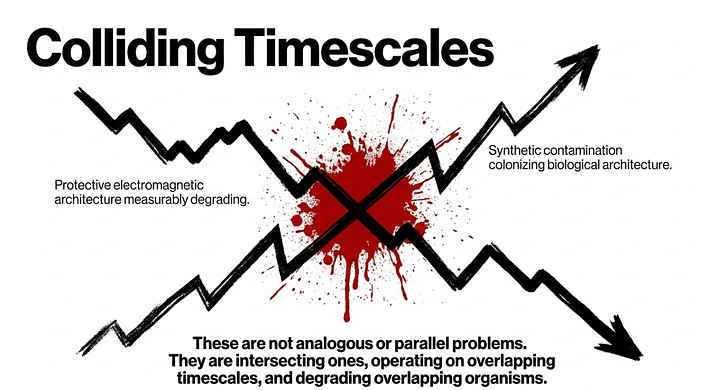
Each of these papers, taken alone, advances a specific scientific question. Taken together, they describe a planetary system in which the protective electromagnetic architecture is measurably degrading while synthetic contamination is simultaneously colonizing the biological architecture. These are not analogous or parallel problems. They are intersecting ones, operating on overlapping timescales, affecting overlapping organisms, and degrading overlapping systems.
Key sources cited in this essay:
Cooper, A. et al. (2021): https://www.science.org/doi/10.1126/science.abb8677
Finlay, C.C. et al. (2025): https://doi.org/10.1016/j.pepi.2025.107447
Marfella, R. et al. (2024): https://www.nejm.org/doi/full/10.1056/NEJMoa2309822
Nihart, A., Campen, M. et al. (2025): https://doi.org/10.1038/s41591-024-03453-1
Tinsley, B.A. & Yu, F. (2000): https://www.sciencedirect.com/science/article/pii/S136468260000135X
Meert, J. et al. (2024): https://www.scientificamerican.com/article/earths-magnetic-field-nearly-collapsed-590-million-years-ago-possibly-spurring-life/
ESA Swarm Mission (2025): https://www.esa.int/Applications/Observing_the_Earth/Future_EO/Swarm/Swarm_reveals_Earth_s_changing_magnetism
World Magnetic Model 2025 Update (2024): https://geomag.colorado.edu/wmm2025-and-wmmhr2025
HR STUDIOS is Creating Award Winning Journalism
Support our workbuymeacoffee.com
There’s no purpose of juxtaposing these two dispirit phenomenon.
Abject Minutia.