Alex Karp: The Insane Billionaire, Mass-Surveilling, Bullied Young Nerd Now Proudly Killing Humans to Get Revenge on the World
How the CEO of Palantir Came from Progressive Parents and Turned Out to Be One of the Most Immoral, Dangerous and Powerful People in the World


Alex Karp grew up in a household that should have produced an activist, not an architect of the surveillance state.

His father, a Jewish pediatrician, spent his days healing children.

His mother, a Black artist, immersed herself in creative resistance, her work steeped in the struggles of marginalized communities.
The Philadelphia home they built was a place where civil rights weren’t just discussed — they were lived. Young Alex, dyslexic and awkward, found solace in philosophy and social theory, disciplines that taught him to question power, to probe the structures that shape society, to stand with the vulnerable against the mighty.
You’d think a man raised like that would spend his life fighting the same fights.
You’d be dead wrong.

The Birth of a Monster — Palantir’s Early Days
Palantir wasn’t born in a garage like some Silicon Valley fairy tale. It was conceived in the shadows of the intelligence world, funded by the CIA’s venture arm, In-Q-Tel, and co-founded by Peter Thiel, a man whose libertarian fantasies often clashed with the realities of human rights. From the start, Palantir’s mission was clear: to build a system that could see everything, predict everything, and control everything.
Karp, the philosopher-turned-tech-executive, became its public face — a man who could articulate the company’s vision in the language of power, not just code.

In its early years, Palantir pitched itself as a tool for counterterrorism, a way to connect the dots that intelligence agencies had missed before 9/11. But the reality was far darker. The company’s first major contracts weren’t just with the CIA or the FBI. They were with U.S. Immigration and Customs Enforcement (ICE), the agency that would become synonymous with family separations, deportation raids, and the criminalization of migration.
And Karp? He didn’t just sign those contracts. He defended them with a zealot’s fervor.

The ICE Machine — How Palantir Became the Deportation Industry’s Brain
By the time Donald Trump took office in 2017, Palantir was already deeply embedded in ICE’s operations. But under Trump, the agency’s brutality reached new heights — and Palantir was right there, fueling the fire.
The company’s Investigative Case Management (ICM) system became the backbone of ICE’s deportation machine. It didn’t just help agents track undocumented immigrants. It supercharged their ability to hunt them down. ICM could pull data from DMV records, utility bills, social media, and even health records to build detailed dossiers on targets. It could map entire neighborhoods, flagging “high-value” areas for raids. It could assign “confidence scores” to addresses, telling agents where to strike.

In 2018, ICE used Palantir’s tools to conduct a raid in Woodburn, Oregon, a town with a large Latino population. Agents descended on an apartment complex, smashed windows, dragged people from their homes, and arrested more than 30 in what lawyers later called a “dragnet” operation. One of those arrested was a 45-year-old woman, pulled from her van at gunpoint. Her crime? Existing in a neighborhood Palantir’s algorithms had flagged as “target-rich.”
When critics — including Palantir’s own employees — protested the company’s work with ICE, Karp’s response was chillingly dismissive.
“I have asked myself if I were younger at college, ‘Would I be protesting me?’” — Alex Karp, 2019
He didn’t just defend the contracts. He mocked the outrage, framing it as naive, as if the suffering of families torn apart by ICE was just collateral damage in a grander mission.

“Our Product Is Used on Occasion to Kill People”
Palantir didn’t stop at immigration enforcement. The company’s tentacles stretched into military intelligence, counterterrorism, and even police surveillance. And Karp didn’t just acknowledge this — he boasted about it.
In a 2020 interview with Business Insider, he dropped a line so cold it sent chills down the spines of civil liberties advocates:
“I see this with our work with clandestine services… I mean, our product is used on occasion to kill people.” — Alex Karp, 2020
This wasn’t a slip of the tongue. It wasn’t a misquote. It was a blunt admission of what Palantir had become: a tool not just for surveillance, but for lethal force.
And Karp wasn’t ashamed. He was proud.
The Gaza Files — Palantir’s Role in a Genocide
If Palantir’s work with ICE was morally bankrupt, its involvement in Israel’s military operations in Gaza was nothing short of complicity in war crimes.
In 2023, as Israel’s bombardment of Gaza escalated, reports emerged that Palantir’s software was being used to identify targets for airstrikes. The company’s AI tools, which could sift through vast amounts of data to pinpoint locations and individuals, were allegedly used to streamline the killing process.
Activists didn’t mince words. At a 2024 conference, a protester confronted Karp directly:
“You’re getting wealthy off of killing Palestinians. Palantir kills Palestinians with their AI and technology.” — Protester at Hill & Valley Forum, 2024
Karp’s response? Silence. Not denial. Not outrage. Just the cold, calculating gaze of a man who knows exactly what his company does — and doesn’t care.

The Philosophical Betrayal — How a Thinker Became a Tycoon of Oppression
Here’s the thing about Alex Karp: He wasn’t always like this.
He didn’t study computer science. He studied philosophy, law, social theory — disciplines meant to interrogate power, to ask who benefits and who suffers, to stand with the oppressed against the oppressor.
So what the hell happened?
Somewhere along the way, the lessons of his upbringing curdled. The man who grew up in a home that valued empathy, justice, and human dignity became the CEO of a company that monetizes suffering.
His parents fought for civil rights. He built tools to erode them.
His mother created art that challenged power. He built software that entrenches it.
His father healed the vulnerable. He profits from their persecution.
This isn’t just a personal failure. It’s a philosophical betrayal — one that has real, devastating consequences for real people.

The Karp Doctrine — Power First, People Never
Karp’s worldview isn’t complicated. It’s brutal in its simplicity:
The West must dominate. Full stop.
Technology is the tool to ensure that dominance.
Moral concerns — privacy, civil liberties, human rights — are secondary to that mission.
He doesn’t just say this in private. He preaches it publicly.
“Not only is patriotism right, patriotism will make you rich.” — Alex Karp, 2025
“We want and need this country to be the strongest, most important country in the world.” — Alex Karp, 2025
“If you’re right a lot, maybe exerting that you’re going to be right tomorrow is pretty important.” — Alex Karp, on his leadership style
This isn’t the language of a man who believes in justice. It’s the language of a man who believes in power.
And power, in Karp’s world, justifies everything.

Stories Palantir Doesn’t Want You to Hear
Behind every data point in Palantir’s system is a human being. Behind every “confidence score” is a family. Behind every “target-rich” neighborhood is a community.
Here are just a few of the lives Palantir’s technology has touched — and ruined.

The Woman in Woodburn
In 2018, ICE agents, guided by Palantir’s ELITE software, smashed the window of a van in Woodburn, Oregon, and dragged a 45-year-old woman out at gunpoint. She was one of more than 30 people arrested that day in a raid lawyers called a “dragnet.” Her crime? Living in a neighborhood Palantir’s algorithms had flagged for enforcement.

The Families Torn Apart
Palantir’s ICM system doesn’t just help ICE find undocumented immigrants. It helps them track down their families. Parents separated from children. Spouses deported while their partners remain. Communities shattered. The human cost of Palantir’s contracts with ICE isn’t abstract — it’s measured in tears, in trauma, in lives upended.

The Civilians in Gaza
When Israel’s military uses Palantir’s AI to identify targets for airstrikes, the results are predictable — and devastating. In 2023 and 2024, as Gaza burned under Israeli bombardment, activists and human rights groups accused Palantir of enabling war crimes. The company’s tools, they said, helped turn civilian neighborhoods into kill zones.
The Protesters at Home
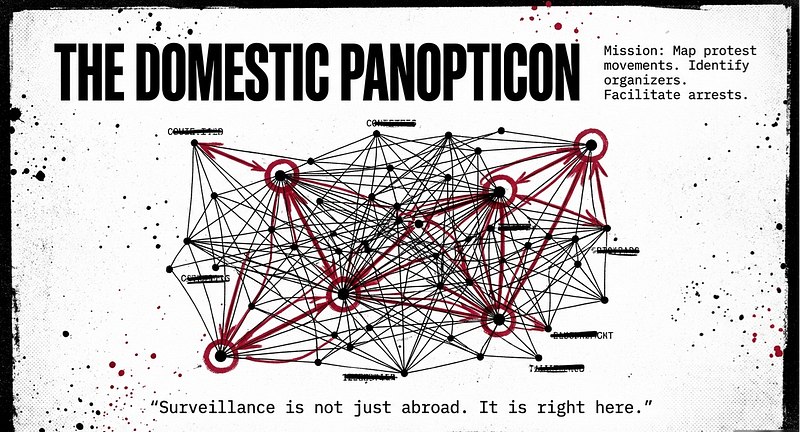
Palantir’s surveillance tools aren’t just used abroad. They’re used right here in the U.S., where police departments and federal agencies deploy them to monitor activists, track protesters, and suppress dissent. In 2020, as Black Lives Matter protests swept the nation, Palantir’s software was used to map protest movements, identify organizers, and facilitate arrests.

The Backlash — When Employees, Activists, and the Public Fight Back
Karp’s vision for Palantir might be clear, but it’s not unopposed.
The Employee Revolt
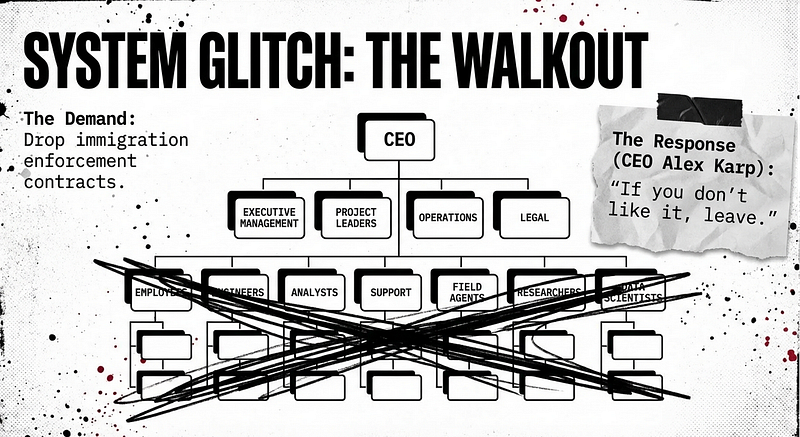
In 2019, as reports of Palantir’s work with ICE spread, employees staged a walkout. They demanded the company drop its contracts with immigration enforcement agencies, arguing that Palantir was complicit in human rights abuses. Karp’s response? “If you don’t like it, leave.”

The Activist Campaigns
Groups like Mijente, the ACLU, and Amnesty International have spent years exposing Palantir’s role in deportations, surveillance, and war. They’ve organized protests, filed lawsuits, and pressured investors to divest. Their message is simple: Palantir isn’t just a tech company. It’s a weapon.

The Public Reckoning
From Columbia University to the streets of Oakland, protesters have confronted Karp directly, accusing him of profiting from genocide, enabling state violence, and betraying the values he claims to uphold. At a 2024 conference, a protester shouted him down, calling him complicit in the deaths of Palestinians. Karp’s response? He kept talking, as if the accusations were nothing more than background noise.

The Karp Paradox — How a Philosopher Became a Merchant of Death
Alex Karp didn’t start out as a villain. He started out as a thinker. A man who studied the structures of power, who understood the ethical implications of technology, who grew up in a home that valued justice over domination.
So how did he end up here?
The answer lies in the seduction of power. Palantir didn’t just give Karp a company. It gave him a kingdom. A chance to shape the world in his image, to bend governments and militaries to his will, to build a machine that could see everything, know everything, control everything.
And somewhere along the way, he stopped asking whether he should.
Alex Karp is now one of the most powerful men in tech. Palantir is worth billions, its software woven into the fabric of governments around the world. He’s courted by presidents, celebrated by investors, and feared by activists.
But his legacy isn’t one of innovation. It’s one of complicity.
He didn’t just build a company. He built a machine of oppression. And he did it with his eyes wide open.
His parents fought for justice. He sold it out.
The question now is simple: What are we going to do about it?
HR STUDIOS is Creating Award Winning Journalism
Support our workbuymeacoffee.com